For this reason, alternatives are typically considered less risky than stocks (if utilized correctly). But why would a financier usage options? Well, buying choices is basically wagering on stocks to go up, timeshare professionals down or to hedge a trading position in the market - what was the reconstruction finance corporation. The rate at which you agree to purchase the hidden security by means of the choice is called the "strike cost," and the charge you spend for purchasing that alternative agreement is called the "premium." When determining the strike cost, you are wagering that the possession (typically a stock) will go up or down in cost.
There are two different kinds of choices - call and put alternatives - which give the financier the right (but not responsibility) to offer or purchase securities. A call choice is a contract that provides the investor the right to purchase a certain quantity of shares (typically 100 per contract) of a specific security or product at a defined cost over a specific amount of time. Nevertheless, the broad outlines are similar. Financial alternatives are utilized either to hedge versus threats by purchasing agreements that will pay if something with unfavorable monetary effects occurs, or because it allows traders to magnify gains while restricting drawback dangers. Financial options involve the threat of losing some or all of the agreement cost, if the marketplace moves against the pattern anticipated, and counterparty dangers, such as broker insolvency or professionals who do not satisfy their legal responsibilities.
Choices trading can be intricate even more so than stock trading. When you buy a stock, you just decide the number of shares you desire, and your broker fills the order at the dominating market cost or a limitation rate you set. Trading options requires an understanding of innovative strategies, and the procedure for opening an options trading account consists of a couple of more steps than opening a typical financial investment account.
( Need to review puts, calls, strike prices and other options trading lingo? See our post on options trading 101). Compared to opening a brokerage represent stock trading, opening a choices trading account requires larger amounts of capital. And, offered the intricacy of predicting multiple moving parts, brokers require to understand a bit more about a possible investor prior to granting them a consent slip to begin trading choices.
You'll require to provide a potential broker: Financial investment goals. This might include income, development, capital preservation or speculation. Trading experience. The broker will wish to know your knowledge of investing, the length fred wesly of time you've been trading stocks or choices, the number of trades you make each year and the size of your trades.
Have on hand your liquid net worth (or investments quickly cost money), annual earnings, overall net worth and work info. The types of options you want to trade. Based upon your responses, the broker generally appoints you a preliminary trading level (typically 1 to 4, though a 5th level is ending up being more typical) that is your secret to putting specific types of options trades.
How To Finance A Rental Property Can Be Fun For Everyone
The broker you pick to trade options with is your crucial investing partner. Discovering the broker that uses the tools, research, assistance and assistance you require is especially important for financiers who are new to alternatives trading. This determines what kind of choices agreement you take on. If you believe the rate of a stock will increase, you'll buy a call choice (how many years can you finance a used car).
As a refresher, a call choice is an agreement that gives you the right, but not the obligation, to buy a stock at an established rate (called the strike rate) within a specific period. A put choice provides you the right, but not the obligation, to offer shares at a stated price prior to the contract expires.
( For call choices, it's above the strike; for put choices, it's listed below the strike.) You'll desire to buy a choice with a strike price that reflects where you predict the stock will be during the alternative's lifetime. For instance, if you think the share cost of a business presently trading for $100 is going to increase to $120 by some future date, you 'd purchase a call alternative with a strike cost less than $120 (ideally a strike price no higher than $120 minus the cost of the choice, so that the alternative remains successful at $120).
Similarly, if you think the company's share cost is going to dip to $80, you 'd buy a put choice (providing you the right to sell shares) with a strike rate above $80 (ideally a strike cost no lower than $80 plus the expense of the option, so that the choice remains rewarding at $80).
You can't choose just any strike cost. Option quotes, technically called option chains, include a variety of available strike rates. The increments between strike costs are standardized throughout the industry for instance, $1, $2. 50, $5, $10 and are based upon the stock price. The cost you spend for a choice, called the premium, has 2 parts: intrinsic value and time value.
Time value is whatever is left, and consider how volatile the stock is, the time to expiration and rate of interest, among other components. For example, suppose you have a $100 call alternative while the stock costs $110. Let's presume the option's military time shares premium is $15. The intrinsic worth is $10 ($ 110 minus $100), while time worth is $5.
Some Of How Long Can You Finance A New Car
Every options contract has an expiration date that shows the last day you can work out the choice. Here, too, you can't simply pull a date out of thin air. Your options are restricted to the ones provided when you call a choice chain. Expiration dates can vary from days to months to years.
For long-term investors, month-to-month and annual expiration dates are more suitable. Longer expirations offer the stock more time to move and time for your financial investment thesis to play out. A longer expiration is also helpful because the alternative can maintain time worth, even if the stock trades below the strike rate.
If a trade has actually broken them, they can generally still offer at any time worth remaining on the option and this is more likely if the choice contract is longer. View Morningstar's top stock picks With a 14-day complimentary trial * of Morningstar Premium, you'll get up-to-date skilled stock research study to help drive your financial investment choices. * Paid subscription afterwards, see Morningstar.
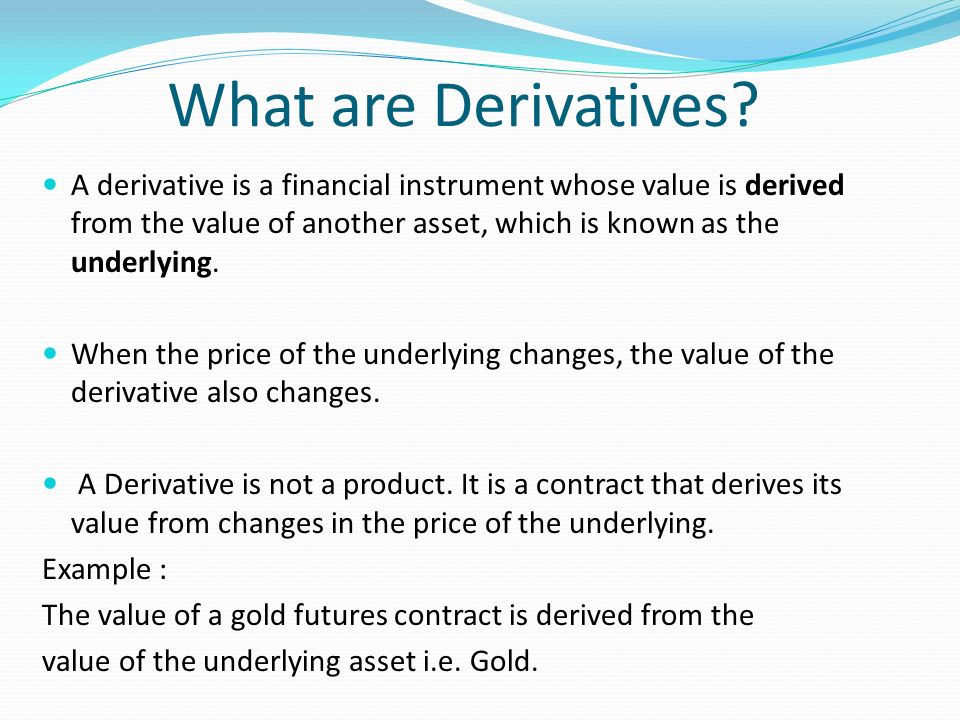
Call and put choices are acquired investments, indicating their cost motions are based on the price movements of another monetary product. when studying finance or economic, the cost of a decision is also known as a(n). The monetary item a derivative is based upon is frequently called the "underlying." Here we'll cover what these choices mean and how traders and buyers utilize the terms. Choices can be defined as contracts that give a buyer the right to buy or offer the underlying property, or the security on which a derivative contract is based, by a set expiration date at a specific cost.